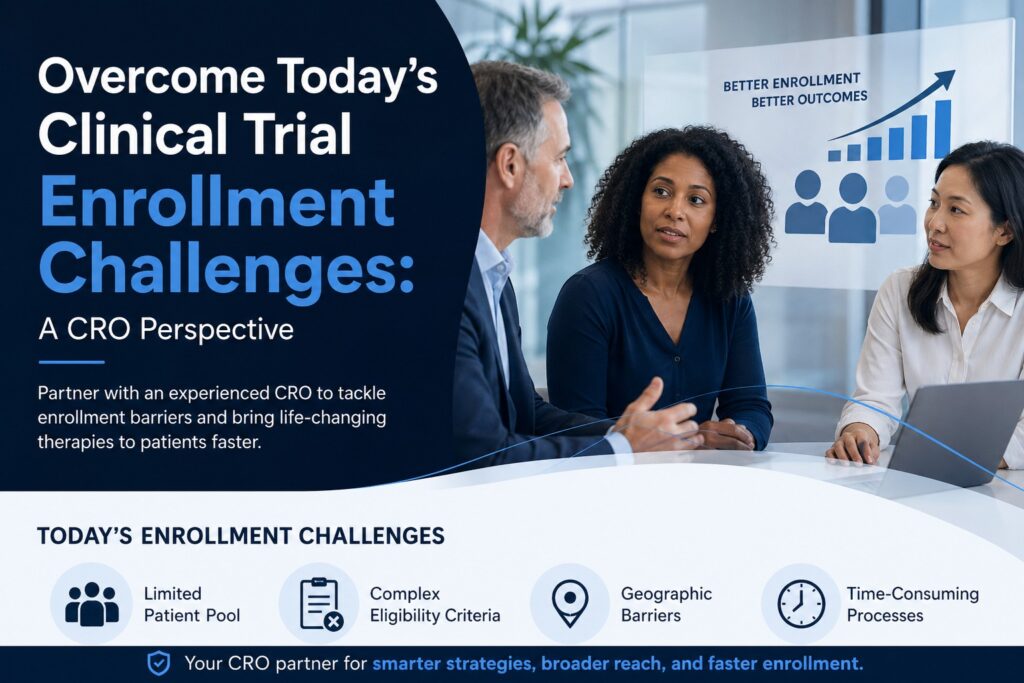
In today’s clinical research landscape, patient enrollment remains one of the most critical—and challenging—drivers of trial success. For Contract Research Organizations (CROs), the ability to consistently meet enrollment targets is no longer just an operational goal; it is a key differentiator in delivering value to sponsors.
As protocols grow more complex and competition for participants intensifies, CROs must evolve their strategies to remain effective, agile, and competitive.
The Growing Complexity of Enrollment
Clinical trials today demand more from both patients and sites. Narrow eligibility criteria, increased protocol burden, and multi-arm study designs significantly reduce the pool of qualified participants.
CROs are uniquely positioned to mitigate these risks early. By leveraging feasibility intelligence, real-world data, and historical enrollment performance, CROs can guide sponsors toward more realistic study designs and better-informed site selection—reducing downstream delays and costly amendments.
Turning Data into Enrollment Advantage
Data-driven recruitment is no longer optional—it is essential. CROs that integrate diverse data sources such as electronic health records, claims databases, and patient registries can identify and target eligible populations with far greater precision.
Advanced analytics also enable proactive decision-making. Predictive enrollment modeling helps CROs identify risks early, adjust timelines, and deploy mitigation strategies such as opening additional sites or optimizing geographic distribution.
This shift from reactive to predictive enrollment management is a major competitive advantage.
Elevating Site Performance
Sites are at the frontline of patient recruitment, and their performance directly impacts trial timelines. CROs that actively invest in site enablement consistently outperform those that take a passive approach.
Providing sites with recruitment tools, pre-screened patient insights, and ongoing training improves both efficiency and engagement. Just as importantly, transparent communication and responsive support foster stronger partnerships and higher retention of high-performing sites.
A well-supported site is a high-enrolling site.
Expanding Reach Through Digital and Decentralized Models
Digital innovation has reshaped how patients discover and engage with clinical trials. CROs now play a central role in executing multi-channel recruitment strategies, including targeted digital campaigns, social media outreach, and online pre-screening platforms.
At the same time, decentralized and hybrid trial models are reducing participation barriers. By minimizing travel requirements and offering flexible visit options, CROs can significantly improve both enrollment and retention—particularly in hard-to-reach populations.
Advancing Diversity and Inclusion
Regulators and sponsors are placing increasing emphasis on diversity in clinical trials, and CROs are critical to delivering on this priority.
Effective diversity strategies go beyond broad outreach. They require intentional engagement with communities, partnerships with local healthcare providers, and culturally appropriate communication. CROs that embed inclusivity into their recruitment models not only meet regulatory expectations but also enhance the scientific validity of trial outcomes.
A Strategic Partner in Trial Success
Enrollment challenges are unlikely to disappear—but how CROs respond will define their role in the future of clinical research.
By combining data-driven insights, strong site partnerships, digital innovation, and patient-centric design, CROs can move beyond execution to become true strategic partners. Those who do will not only meet enrollment goals but consistently deliver faster, more efficient, and more inclusive trials.